Workshops, process docs, and legacy data go in. BRDs, integration mappings, UAT scripts, and risk flags come out — no manual rewrite when the program changes.
Ingest workshops, process scope, architecture exports, data files, and project documents from the systems teams already use.
Connect process truth, architecture truth, and project scope into one execution model with traceable provenance.
Generate BRDs, FSDs, interface mappings, UAT packs, and control outputs from aligned transformation context.
When scope shifts, Launch Layer flags stale artifacts, retest scope, and delivery risk so teams know what changed.
Real programs span process platforms, architecture systems, ERP cores, middleware, and local tooling. Launch Layer links that context to execution.
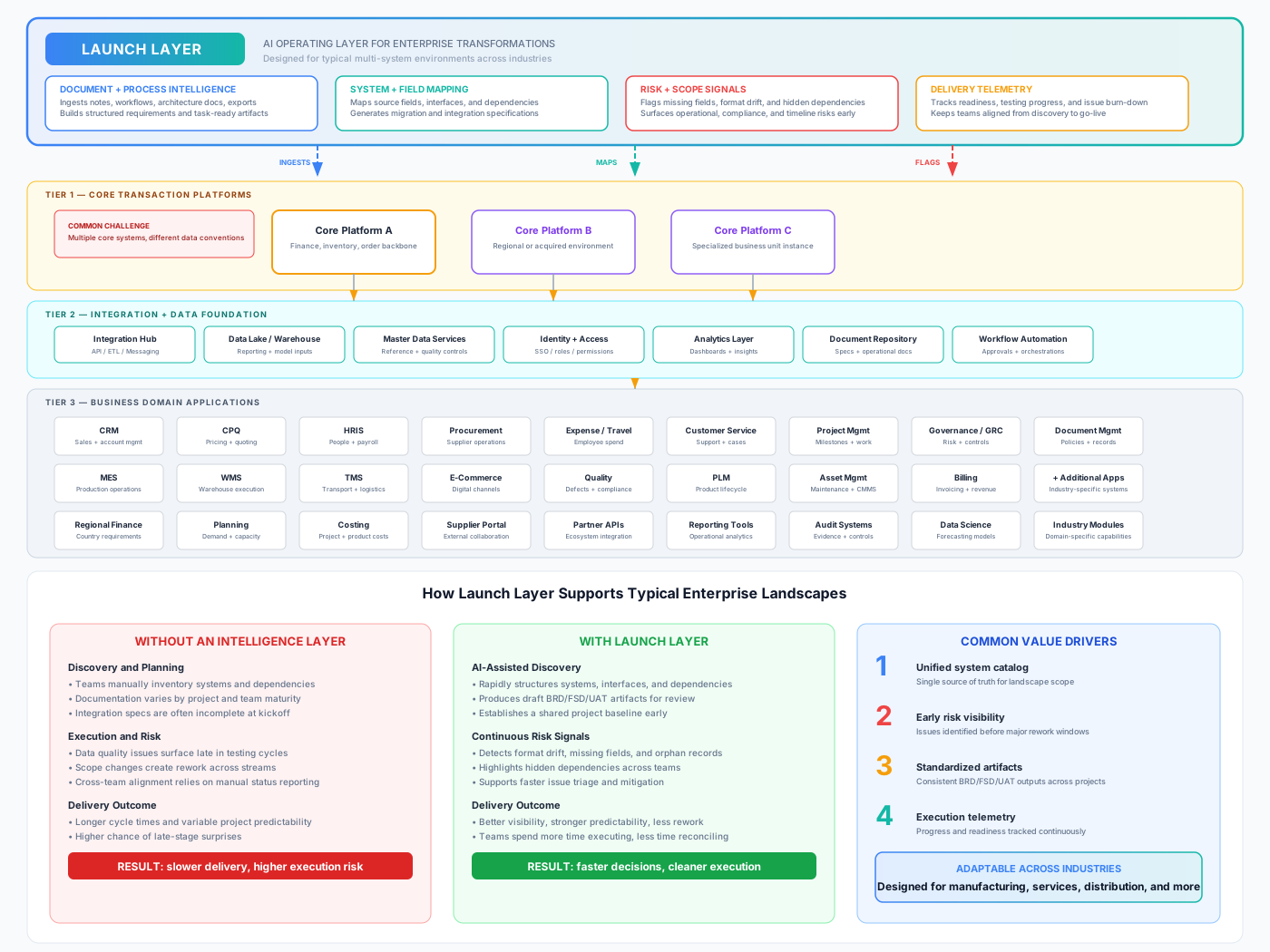
Reads documentation, data exports, and API specs from core ERPs, middleware, and every connected business application. Nothing is out of scope.
Auto-generates field-level integration maps. Identifies format mismatches, data model differences, and transformation rules needed for migration.
Detects multi-ERP fragmentation, non-standard data formats, missing fields, and compliance-critical systems that haven't been addressed.
Ingests workshop transcripts, process scope, architecture context, and project documents to build structured execution inputs automatically.
Upload a 90-minute workshop recording. Launch Layer produces a structured BRD with field-level requirements, decision log, and open items — ready for stakeholder review, not a blank template.
Turns process and architecture context into field-level specs, mapping logic, validation rules, and delivery-ready integration outputs.
Mapping a Salesforce-to-SAP integration? Launch Layer reads both schemas and generates the spec:
Salesforce.Account.BillingAddress → SAP.BP.ADDR1_DATA
Including currency conversion rules for LATAM accounts and date format transformations per region.
Scans data, scope, and architecture changes to find issues before they become delivery surprises, then flags affected downstream artifacts.
"CRITICAL: 4 separate ERP instances detected across locations. Infor Visual (Melbourne FL) uses a fundamentally different data model than Infor LX. Customer table contains 5 distinct date formats. TradeSphere (compliance-critical) has not been addressed in the migration plan."
Tracks readiness across requirements, testing, mappings, and go-live controls so delivery teams can act before weekly status catches up.
Instead of a status meeting to learn that integration testing is behind, you see it in the dashboard the moment a dependent system mapping falls out of sync. No waiting for the weekly report.
Not dashboards for the sake of dashboards. These are the artifacts your project actually needs.
Auto-generated BRDs from ingested meeting notes and process documentation. One per system or integration.
Field-level FSDs with data types, transformation rules, and validation logic for every mapped connection.
Generated from requirements and mappings. Each script validates a specific data flow end-to-end.
Field-level mapping specs between source and target systems with format conversion rules flagged.
Data quality issues, format conflicts, missing fields, and compliance gaps — surfaced on Day 1, not Month 8.
Living inventory of every system, its criticality rating, integration dependencies, and migration status.
Scans exports for duplicate records, inconsistent formats, orphaned references, and missing required fields.
Real-time telemetry on migration progress, test coverage, scope changes, and go-live readiness.
Here's what a typical mid-market manufacturer's application landscape looks like. Launch Layer catalogs and maps every system in it.
Your landscape might be simpler — that's fine. A company with 5 systems and 1 ERP gets the same automated mapping, risk detection, and document generation. Launch Layer scales to the complexity you have, not the complexity you don't.
Three connected loops make this more than a generic AI feature: trusted delivery workflow, learning moat, and measurable project economics.
Speed from AI draft, trust from human approval, and better output every cycle.
ERP-specific rules and project feedback compound into a proprietary execution graph competitors cannot clone overnight.
The model is simple: compress discovery, catch risk earlier, and improve SI margin per project.
Value play: we do not compete as a chatbot. We become the execution layer between discovery and delivery, where every approved output and every correction improves the next project.
Side-by-side outcomes from ERP transformation projects of comparable complexity.
Upload a single document — a meeting transcript, a process diagram, a data export — and see what Launch Layer finds. No setup required.